
Rumor Has It...

Rumor Has It...
In my first blog post as the History Room Librarian on Feb 7th 2020, I wrote about the Petaluma River.
In this post, I noted that the Petaluma Creek, as it was known until 1959, officially became the Petaluma River after an act of Congress was passed “enabling it to receive federal funding to cover the expensive process of dredging”.
Here’s what I wrote then:
Through the years, the improvement of Petaluma Creek had its ups and downs with community desire and financing determining the ability to complete a regular dredging. It was in the late 1950s that newly elected Congressman Clem Miller discovered that regulations in Washington determined whether a town could access the Army Corps of Engineers financing and assistance for dredging. Turns out – they’d dredge a river; but not a creek. This was a hurdle that Congressman Miller was determined to climb.
Historian John Sheehy begs to differ with that story and states that:
"Contrary to popular lore, the name change was not required to maintain federal funding for the dredging. Instead, Petaluma believed that “river” would carry more prestige than “creek” in helping the town attract new industries in need of water transportation." (Oyster Shells: Petaluma’s Secret Sauce” in his blog: Petalumahistorian.com: https://petalumahistorian.com/petalumas-secret-sauce/)
At the time, I was certain that I had found all the information needed to determine if the statement that the Army Corps of Engineers would dredge a river, but not a creek, was true. But… I hadn’t and…
… turns out I was wrong.
It was time to dig a little deeper. This deeper dive through newspapers, Congressional Records, and government agency documents showed me that there was plenty of proof through the years that the Army Corps of Engineers would indeed spend money on creek enhancements and other projects including surveys, dredging, and other operations through the years.
On one of the key dates, 1880, a major in the Army Corps of Engineers initiated a project to dredge and straighten the creek to make it a reliable venue for shipping. This project was completed in 1883.
Why was (and still is) the Creek so important to Petaluma?
The Petaluma Creek has long been a vital resource for transportation and recreation. As the settlement grew into a city in the late 1800s, its purpose grew along with its many industries.
The author of an article in the Petaluma Daily Argus on Feb. 28, 1885, declared in no small terms that this should be called a River… and that the name officially given to it: Petaluma Creek, was a sacrilege that goes beyond belief.
Regardless, the name that was placed on maps up until the name change in 1959 was “Petaluma Creek”. This name had endured over 100 years of recognition in maps, legal documents and in everyday life.
As the years went by, City leaders worked to get federal funding for varying projects with positive results.
The Daily Morning Courier on July 18, 1922 shared the good news that creek work had been approved.
And by 1925, Petaluma was definitely a bustling and growing City with leaders ready to spread the word that businesses located here had the opportunity to utilize the creek to increase their markets.
To share these accomplishments – most notably a large tonnage that bespoke the many industries residing in Petaluma already -- they sponsored a visit for California legislators which highlighted the news that Petaluma’s industry, predominately chickens and eggs, was big business and relied on a navigable river. These presentations offered insight to legislators and government agencies as to just how much use the River provided.
As other industries grew, the importance of the river grew alongside.
And while the newspapers may have used “river” and “creek” interchangeably…understanding that the creek really was more than just a small rivulet of water was an important public relations step that was needed to invite business concerns.
|
To read about the growth of the oyster shell industry and the impact of the creek on it after the war, see: |
Understanding that the creek really was more than just a small rivulet of water was an important public relations step that was needed to invite business concerns.
There was lots happening in this little town throughout the 1930s and 40s. But it was after World War II when Petaluma grew quickly – from a population of 8,000 in 1940 to 14,035 by 1960, that such growth created big changes across the board.
But.. as 1958 rolled on, there was much discussion about dredging, surveying, and creating a harbor among other river activities after Congressman Miller met with Petaluma stakeholders to discuss this post-war growth and the need to meet the demands of housing, commerce and tourism.
Meeting with each group actively advocating for change and funding, one of the things he did right away was to present a bill to Congress to change the name from Petaluma Creek to Petaluma River.
The stakeholders with whom he met came from a wide variety of perspectives from the Petaluma Chamber of Commerce, Santa Rosa, and other cities north of Petaluma to promote business and encourage their locating in Petaluma next to a viable transportation outlet; while others advocated for harbor and recreation availability. The creek had much to offer this growing community.
And yes… at this point in time our creek was indeed…still a creek. As columnist Bill Sobranes weighs in on February 19, 1959:
After Congressman Miller presented his bill, it moved forward quickly.
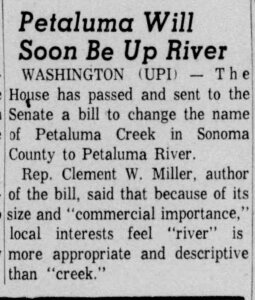
It was sent to the Senate in June….
….where in a report to accompany the bill, an explanation from the Committee on Public Works outlined the interest of civic groups and others to change the name because really, it’s an important body of water and “river” describes it more appropriately.
The Argus published the big story on August 29, 1959 -- President Eisenhower signed the name into law
Clem Miller, in talking at a forum later that year (Argus-Courier Oct. 2, 1959) reminded readers of the many steps that had to be taken to get to this name change.
So why/how did the rumor begin that the Army wouldn’t fund a creek? One of the earliest references to this mistaken assumption is found in a 1973 Bill Soberanes column.
Note: Historian John Sheehy pointed out to me that Bill’s source, Dr. L.J. Snow, a local chiropractor in town, mistakes Congressman Miller for a previous congressman, Clarence Lea.
That is indeed a mistake. While Lea worked hard to get creek funding during his long tenure from 1917 through 1949, this was well before the launch of active promotion for a name change.
That reasoning was further reinforced by an interview with longtime Petaluma resident Newt Dal Poggetto conducted in 2014 by the Sonoma Baylands Oral History Project and presented in their work Sonoma Baylands Oral History Project:
Speaking of Clem Miller, who succeeded Hubert Scudder as Congressman, Poggetto said: “It was Petaluma Creek, until Clem Miller got it and named it a river. Clem Miller was a very bright guy and a friend of mine. When he got back to Washington, he found out that if you would change the name of a stream to a river, creek to a river, you qualified for the Corps of Engineers’ budget. Spending money! So he got Congress to change the name of Petaluma Creek to Petaluma River. They qualified then to dredge it and get federal funding and to build levees." (https://sonomalandtrust.org/wp-content/uploads/2023/09/Baylands_Oral_Histories_FINAL.pdf, p. 19)
That interview was cited in 2019, in an article in the Petaluma Argus-Courier and Santa Rosa Press Democrat by Sonoma County historian Arthur Dawson, whose article was then referenced by the City of Petaluma on its official website: https://cityofpetaluma.org/petaluma-river-once-considered-a-creek/
Petalumans have always loved their river. Whether we’re kayaking, fishing, wandering alongside it on the footpath at Shollenberger Park or waiting for Santa Claus to sail up and greet us, we have many opportunities to enjoy our river.
There are changes and challenges ahead as we work together to create river-based activities from recreational, to the creation of River Park, the turning basin trestle…and to keep dredging and other maintenance on-going to ensure its longevity as the connector it is.
The story of our river is indeed a story to know.
Thank you to John Sheehy for a lively discussion and much assistance on this topic. A deep dive is still in the works as I’m waiting for more information on our River from the National Archives and the Bancroft Library about the conversations between Clem Miller and the Army Corps of Engineers. Who knows what might pop up? Stay tuned.
And a thank you to Katie Watts for edits and revision changes.